
Tool guide · Experimental alpha
Bass Lab
All features are open to everyone during alpha. No sign-in required.
Experimental alpha · Open to everyone. Generated lines, notation, fingering and playback may contain mistakes, and features may change. Use your ears and judgment as you practice.
Back to practiceJazz bass, one ingredient at a time
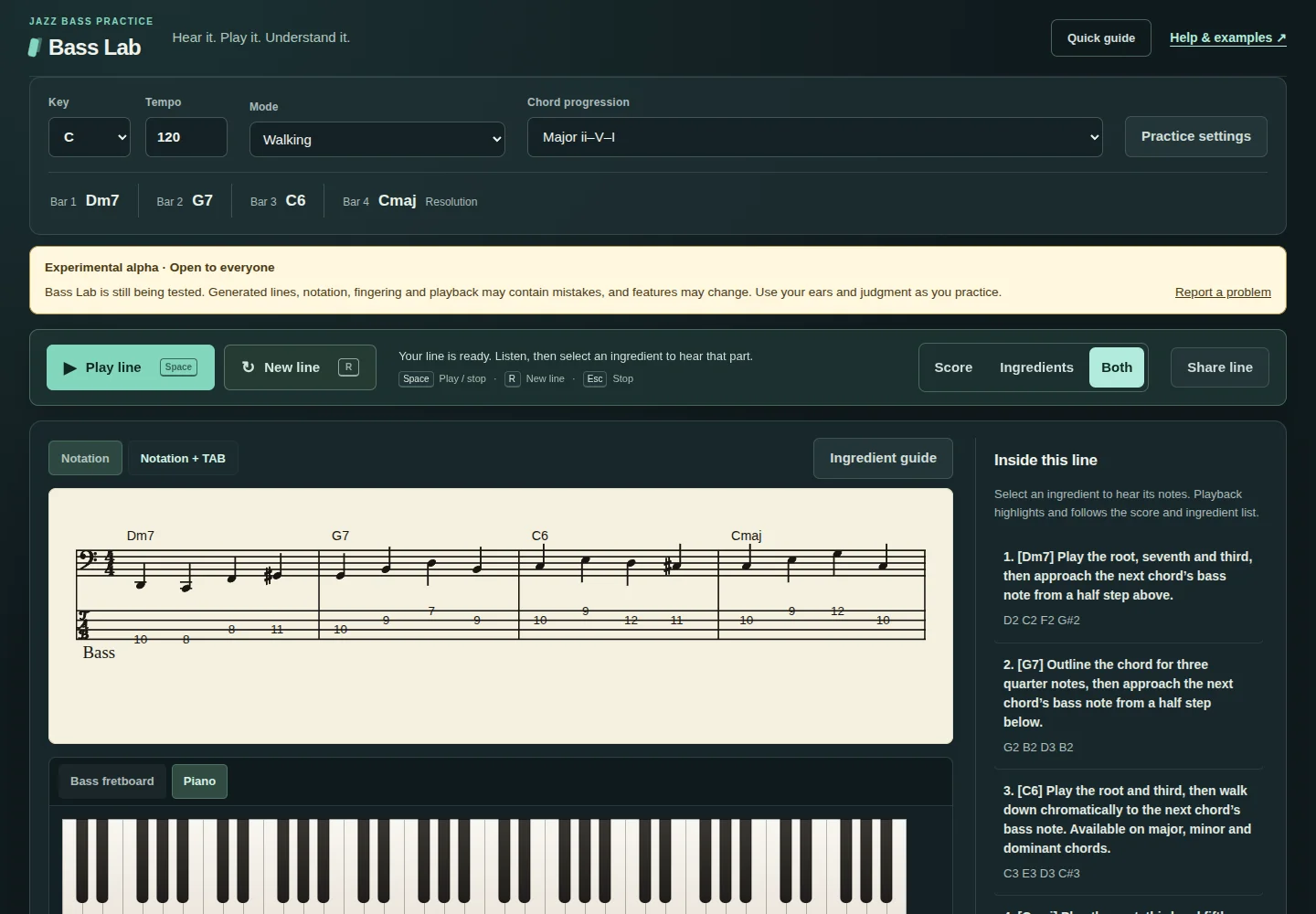
Choose a key, mode and chord progression. Generate a line, then play it or select an ingredient in the recipe to hear it on its own. Chords in brackets identify the backing harmony; the notes beneath each row show the realized bass pitches.
Customize a line
Open Customize your lines to edit chord changes or choose ingredients. Require once includes a chosen ingredient at least once for testing or making an example, even if its checkbox is off. Other cells come from the checked vocabulary. Choices that cannot complete a line with the current settings are unavailable; an existing requirement stays selected with an explanation if the changes no longer fit. Clear it to return to a freely chosen line.
Ingredient choices and weights
Ingredient checkboxes control the vocabulary included in random generation. Check the ingredients you want. Open Ingredient frequency to adjust how often they appear. Only cells compatible with the current mode can be generated. Per-bar permissions can narrow those choices further.
Eighth-note triplet variations
Triplet fills are complete ingredients: Triad Drop and Ghost Drop retain their own rhythm regardless of the modifier. Allow eighth-note triplet variations adds occasional beat-one variations to the five regular walking chord-tone cells. Each variant keeps its original first note, adds two chord-tone attacks inside that beat, and preserves later beats. At most two cells per line receive a variant. The recipe identifies each variation.
Edit chord changes
Set the actual backing chord for each bar or half-bar. Thirds and fifths follow its chord quality. Start on the root. For slash chords, use the note after the slash as the starting bass note: C/E starts on E, while C remains the chord root. A target note is the note you are heading toward; an approach note leads into it. A half-bar uses the beginning of an ingredient rather than squeezing an entire bar into half the time.
Practice settings and instruments
Use the tempo control to set your practice speed. Practice settings includes metronome and count-in options, bass and accompaniment sounds, and their octave shifts. The bass fretboard and TAB use four-string E–A–D–G tuning. Bass clef shows concert pitch. The piano shows the sounding bass notes in the lower register and accompaniment above.
Explore the 28 ingredients
Each mode has its own compatible cells. The blues and funk exercises here use straight timing. Select a recipe row to hear that part of the generated line.
Walking
- Root, Third, Fifth, Approach — Outline the chord for three quarter notes, then approach the next chord’s bass note from a half step below.
- Root, Seventh, Third, Approach — Play the root, seventh and third, then approach the next chord’s bass note from a half step below.
- Root, Fifth, Third, Approach — Play the root, fifth and third, then approach the next chord’s bass note from a half step above.
- Triad and Root Return — Play the root, third and fifth, then return to the root in quarter notes.
- Repeated Root and Fifth — Play two roots, then two fifths in steady quarter notes.
- Two-Note Approach from Below — Play the root and third, then walk up chromatically to the next chord’s bass note.
- Two-Note Approach from Above — Play the root and third, then walk down chromatically to the next chord’s bass note. Available on major, minor and dominant chords.
- Chromatic Walk Up a Fourth — Root, second, flat third, major third, then the next root a semitone higher. Requires a root a fourth above.
- Minor ii–V Chromatic Walk — Root, flat second, flat third, major third into a dominant root a fourth above. Requires a half-diminished ii chord.
- Surround the Next Bass Note — Play the root and third, then enclose the next chord’s bass note from a half step above and below.
- Approach, Surround, Resolve — Play the root, then approach the next target note from a whole step above, a half step above and a half step below. The whole-step approach must belong to the current chord or scale.
- Descending Triplet Drop — Play high root–fifth–third as light eighth-note triplets, then land on the lower root on beat two. Major and minor triads only.
- Root–Fifth–Ghost Triplet — High root, fifth and a light, shortened open-string ghost on the fifth’s string; lower root on beat two. The open pitch is intentional, not a fully muted click.
New chromatic connectors require full bars and a following harmony. Triplet drops also work in half-bars, with the lower-root landing intact. A finite line finishes on its starting bass note; it does not approach an unheard next bar. Required choices report incompatible changes instead of substituting another cell. Enclosures and drops have low default weights, and ordinary cells are preferred between embellishments when enabled.
The ghost drop uses a quiet, shortened open-string sound, marked “ghost” above its actual pitch and open-string TAB. It is distinct from a fully damped, unpitched attack. Triplets occupy one beat and are not swung again.
Two Feel
- Root and Fifth Two Feel — Play the root, then the fifth in half notes.
- Repeated Root Two Feel — Repeat the root in half notes.
- Root and Third Two Feel — Play the root, then the third in half notes.
- Two Feel With an Approach — Play the root, then approach the next chord’s bass note from a half step below. Use two half notes.
Melodic Bass
- Triad Return With Space — Outline the chord, return to its root, then leave a beat of space.
- Repeated Triad Cell — Play root–third–fifth, then repeat the phrase in the same rhythm.
- Neighbor and Return Phrase — Leave the root for a whole-step upper neighbor, return to the root, outline the chord, then leave space.
- Chromatic Root Approach — Play the starting bass note, approach the root from a half step below, then play the third and leave space.
Bossa Nova
- Bossa Root/Fifth Anticipation — An authored root/fifth exercise with restrained anticipation and connected support.
- Bossa Alternating Root and Fifth — An authored variation: sustain root and fifth on the strong beats, with short returns just before each next half-bar.
Blues
- Chord-Aware Blues Riff — An authored chord-tone blues exercise with space; it follows the current chord tones.
- Blues Chord-Tone Answer — A straight-time riff: hold the root, then answer with the third, fifth and root.
Jazz Funk / Soul
- Jazz Funk Root/Fifth With Space — An authored syncopated root/fifth exercise with intentional space; no exact source cell is claimed.
- Jazz Funk Chord-Tone Offbeats — An authored straight-eighth exercise: short root, third and fifth attacks with offbeats and space.
- Jazz Funk Repeated Root Answer — A straight-eighth exercise: repeat the root, leave space, then answer with the fifth and third.
Sources
The vocabulary draws on TalkingBass and Discover Double Bass lessons about chord tones, approaches, voice leading, phrasing and rhythmic variation. Generated exercises are authored practice material, not transcriptions of a recorded performance.
Save a line
Share line captures the exact notes, rhythm, TAB, chords and settings. Full links work without the short-link service. Imported lines and edits in that shared session do not replace your saved personal preferences and do not start playback automatically.